Best Barcode Scanner POS Is Either Working for You or Against You There Is No Middle Ground
The inventory scanner you use to receive products in the back of your store should not be running your front-end checkout. That sentence sounds obvious. And yet small business owners across retail, food service, and healthcare are running exactly that setup every day, wondering why their checkout lines move slowly, why their inventory counts never match, and why their staff treats the POS like a problem to work around rather than a tool that makes the work easier.
A barcode scanner POS is not a commodity purchase. It is an operational decision that determines how fast your checkout moves, how accurately your inventory tracks, and whether your staff can do their jobs without friction at the point of sale. When you get that decision wrong, the cost is not a one-time hit. It compounds, transaction by transaction, shift by shift.
This is the breakdown of what separates a scanner checkout system that performs from one that quietly bleeds your operation. Dataonems works with small and mid-size businesses to match barcode POS hardware and software to the actual demands of the environment, not the demands of whatever was easiest to bundle into a signup agreement.
The Problem Is Not the Barcode. It Is the Integration.
Most small business owners discover the limitation of their barcode pos integration the same way: at the worst possible moment. A Saturday rush. A line at the counter. A scan that does not register. A system that takes four seconds to return a price when it should take less than one. By the time the problem is visible, it has already been costing them for months.
The scanner itself is rarely the failure point. Barcode hardware is mature technology. What fails is the connection between the scanner and the software layer: the pos integration that is supposed to pull product data, update inventory, apply pricing rules, and log the transaction in real time. When that integration is slow, incomplete, or mismatched to your operational environment, every scan becomes a potential delay.
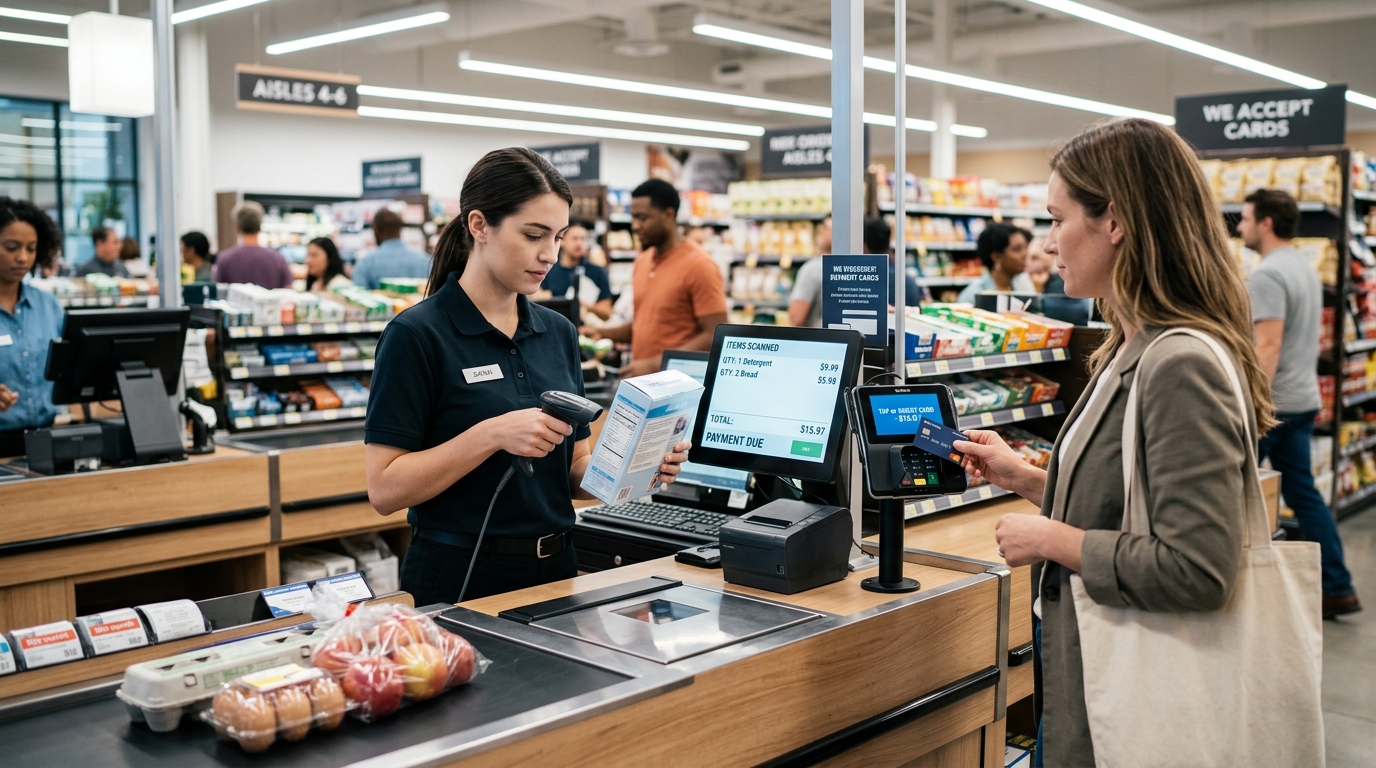
Retail barcode software built for a 50-SKU boutique does not perform the same way when you scale to 3,000 SKUs across multiple locations. A scanner checkout system designed for a single-register coffee shop does not handle the concurrent transaction volume of a mid-size grocery. Matching the system to the actual operational load is the decision that separates businesses with smooth checkout from businesses with a bottleneck they cannot identify.
Speed Is a Specification, Not a Feature
When evaluating a fast scan POS, speed is not a marketing claim to take at face value. It is a measurable specification with a direct impact on your checkout throughput. The number that matters is scan-to-display latency: the time between the scanner reading a barcode and the correct product information appearing on the register screen. In a high-performing system, that number is under 500 milliseconds. In an underperforming one, it stretches to two, three, or four seconds.
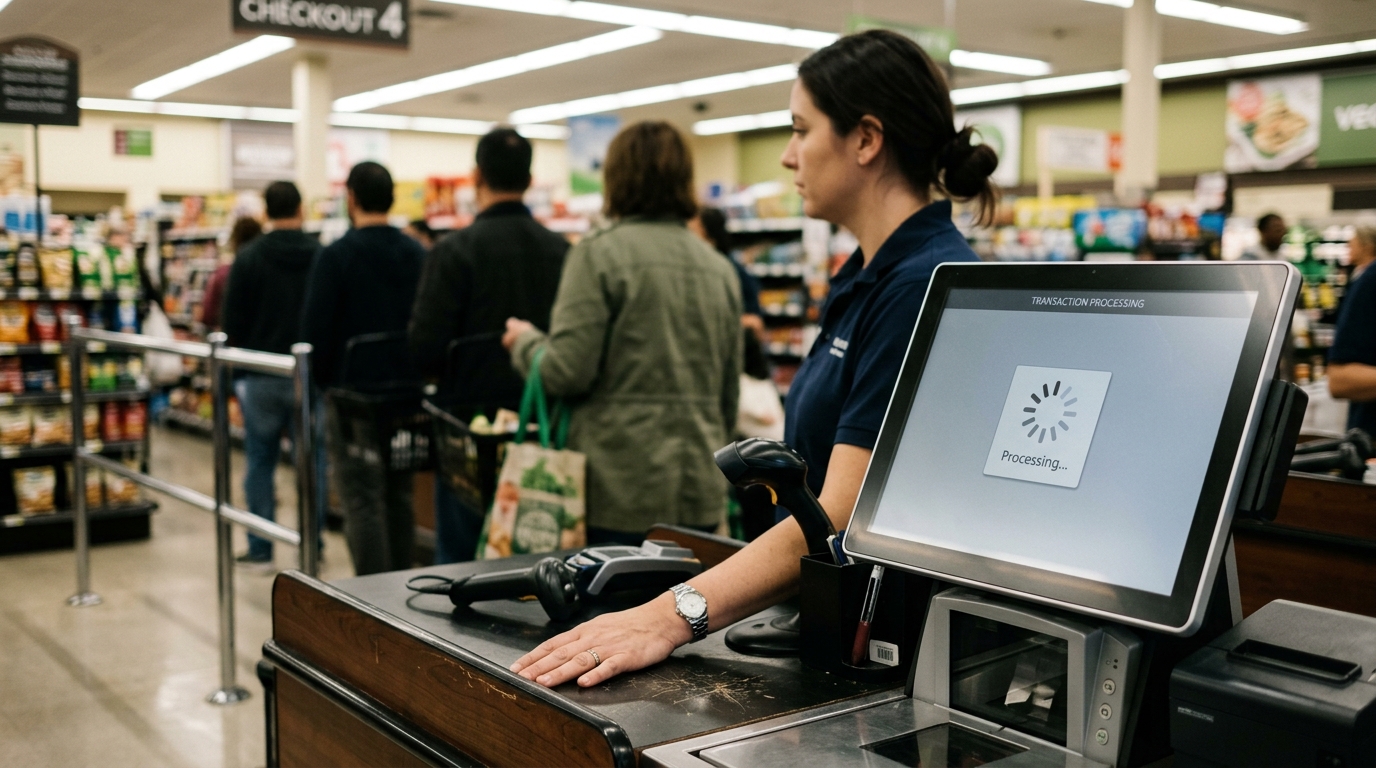
Four seconds per scan does not sound like a crisis until you run the math. A cashier scanning 30 items in a transaction at four seconds per scan adds two full minutes to that checkout. In a lunch-rush environment processing 40 transactions an hour, that delay translates to over an hour of compounded wait time across your customer base every single day. The customers who leave the line before purchasing are not counted in your lost revenue reports. They simply do not appear.
A checkout barcode system that cannot guarantee sub-second scan response under real operating load is not a fast scan POS. It is a standard POS that moves slowly enough to create visible friction, one of the clearest signals a customer receives that your business is not optimized for their time.
What Small and Medium Businesses Get Wrong About Retail Barcode Software
Small and Medium Businesses Get Wrong About Retail Barcode Software
The selection mistake that repeats most consistently is choosing retail barcode software based on what is easiest to set up, rather than what is built for their operational model. Consumer-grade and entry-level systems earn their market share by being frictionless to onboard. They are not built to be frictionless to operate at volume, under real conditions, with staff who were not trained by the vendor.
The specific failure modes are predictable. Inventory discrepancies that require manual reconciliation every week. Product databases that do not sync across locations in real time, producing different prices at different registers. Checkout barcode tools that handle standard UPCs cleanly but fail on custom SKUs, weighted items, or bundled products. POS software that performs well with 500 items and degrades noticeably when the catalog grows past 2,000.
These are not edge cases. They are the documented limitations of systems built for a smaller operational scope than the business that purchased them. The cost accumulates in staff time spent on manual corrections, in customer dissatisfaction from pricing errors, and in inventory decisions made on data that does not reflect reality.
Store Scanner Payments: Where POS and Payment Infrastructure Intersect
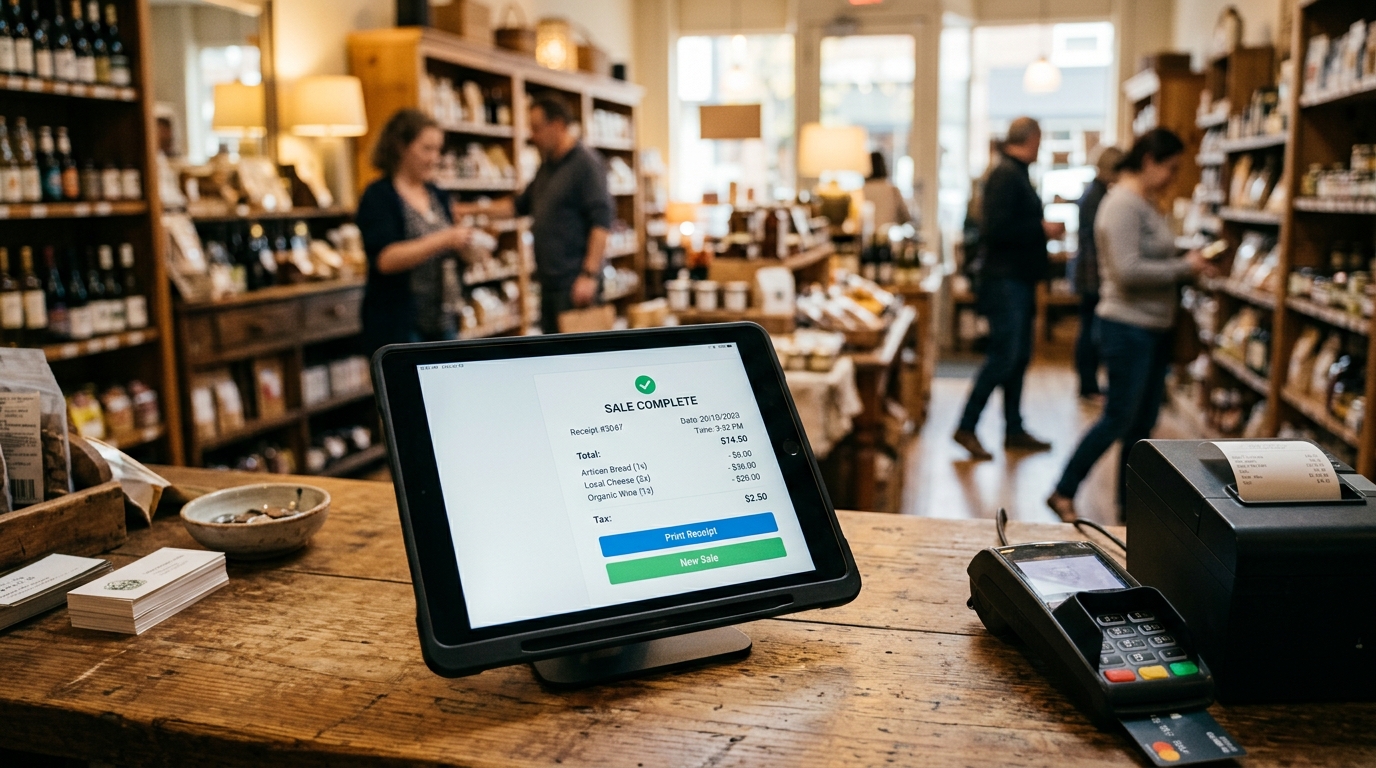
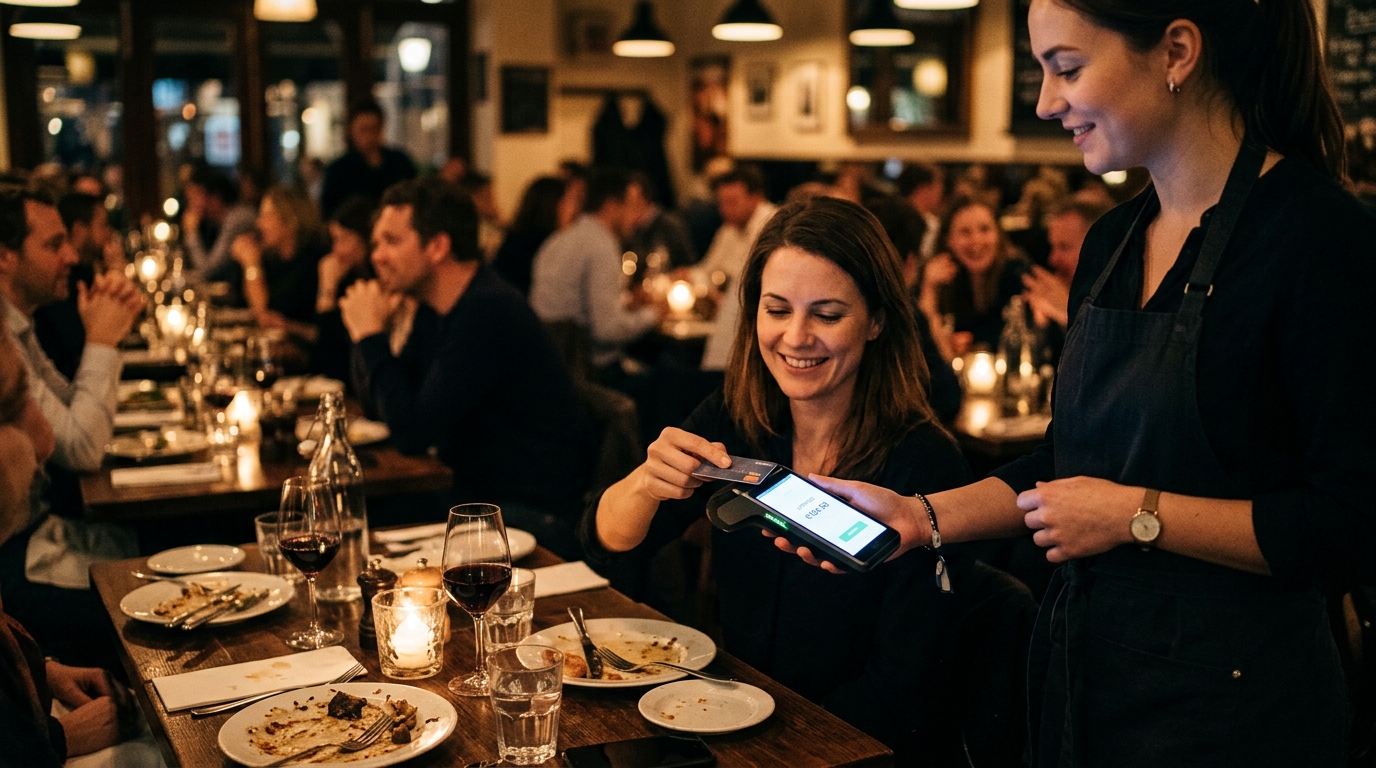
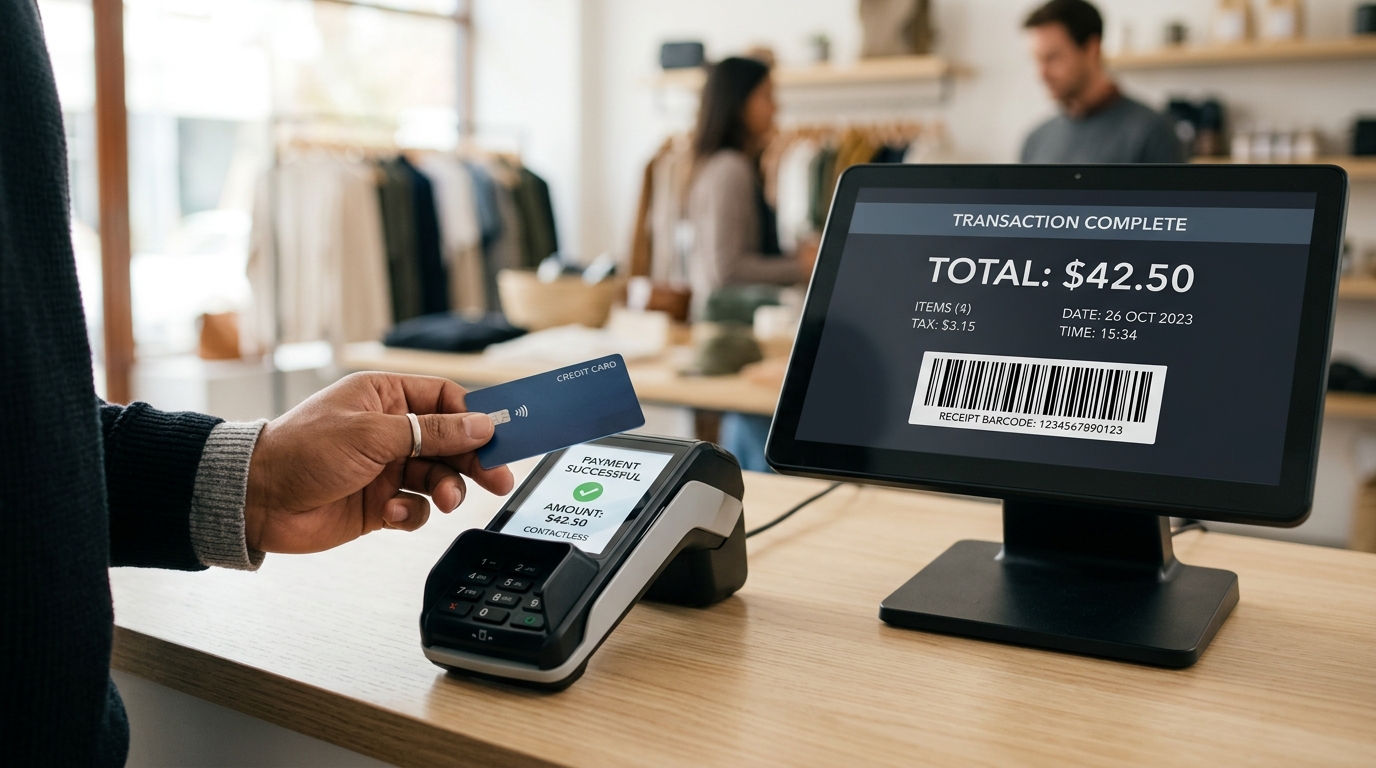
A barcode pos integration that does not connect cleanly to your payment stack creates a gap at the most critical point in the transaction. Store scanner payments fail when the POS systemand the payment terminal are not built to communicate natively: the cashier scans, the total appears on the register, and then a manual entry or separate device completes the payment. That gap is where errors happen, where transactions are voided incorrectly, and where end-of-day reconciliation becomes a time-consuming problem.
Integrated store scanner payments eliminate that gap. The scan triggers the item lookup, the register builds the total, and the payment terminal receives that total directly without manual re-entry. Refunds post against the original transaction. Discounts apply at the POS level before the payment amount is passed to the terminal. The entire transaction is a single record, not two separate entries that require manual matching at the end of the night.
For businesses processing high transaction volume, that integration is not a convenience. It is the difference between a payment operation that is auditable and one that requires human correction as a standard part of the daily workflow.
How to Evaluate a Barcode POS Integration Before You Buy
The evaluation process starts with your catalog and your transaction volume, not with a vendor demo. How many SKUs does your system need to handle today, and what does growth look like over the next 24 months? How many registers or scan points run simultaneously? Do you manage inventory across multiple locations, or from a single point? The answers define the minimum specification your barcode pos integration must meet.
Then test the system under your conditions, not the vendor’s demonstration conditions. Ask for a trial with your actual product catalog loaded, not a sample database. Measure scan-to-display response time under concurrent transaction load, not in a single-user demo environment. Confirm that your payment processor integrates natively, not through a third-party bridge that adds latency and a potential failure point.
Verify the support model. A checkout barcode system that goes down on a Saturday afternoon needs a resolution path measured in minutes, not hours. If the vendor’s support structure does not match your operating hours, that is a business continuity risk that belongs in the decision, not the fine print.
Finally, negotiate processor terms with the same discipline you bring to any other vendor contract. The hardware cost is visible. The processing fees on every transaction over the life of the contract are not. Run the math on your average monthly volume before you sign.
The Verdict
A barcode scanner POS that cannot keep pace with your checkout volume is not a neutral piece of infrastructure. It is an active drag on your revenue, your staff performance, and your customer experience. The businesses that discover this too late are not businesses that made uninformed decisions. They are businesses that made the most common small business decision: they chose the system that was easiest to start, without running the math on what it would cost to operate.
The standard for a barcode pos integration today is not complicated: sub-second scan response, full catalog capacity, native payment integration, and a support model that matches your hours. Every system you evaluate either meets those specifications or it does not. The ones that do not are not bad fits for your business. They are the wrong tools for the work.
DATA ONE works with small and medium businesses to match payment and POS infrastructure to the actual requirements of their operations. If your current barcode setup is creating friction instead of eliminating it, that is a solvable problem and solving it starts with an honest assessment of what your checkout environment actually demands.Book your free operations audit →
Tables
These unsightly stains
Noticing brown spots on your ceiling
How Infectious Diseases Affect the Brain
Laudantium totam
Was sollte alles in einem stehen?
Accusantium doloremque
Using sound to model the world
Nemo enim ipsam
Common Skin Care Myths
Eritatis et quasi
Cards
Card Style One
Lorem ipsum dolor sit amet, consectetur adipiscing elit. Suspendisse varius enim in eros elementum tristique. Duis cursus, mi quis viverra ornare, eros dolor interdum nulla, ut commodo diam libero vitae erat. Aenean faucibus nibh et justo cursus id rutrum lorem imperdiet. Nunc ut sem vitae risus tristique posuere.
Card Style Two
It has survived not only five centuries, but also the leap into electronic typesetting, remaining essentially unchanged.
A barcode scanner POS system is a point-of-sale setup that uses barcode scanning hardware to identify products and trigger transactions within a connected software platform. The scanner reads the product code, the software returns pricing and inventory data, and the transaction is logged in real time. The quality of the integration between hardware and software determines whether the system performs reliably at scale.
What is barcode POS integration?
Barcode POS integration is the technical connection between your scanning hardware, your point-of-sale software, your inventory database, and your payment processing system. When properly built, a single scan updates inventory, retrieves pricing, and initiates the payment in one seamless sequence. When poorly built, those systems operate separately, requiring manual steps that introduce error and slow down checkout.
What should a fast scan POS system be able to do?
A fast scan POS returns product information to the register screen in under 500 milliseconds from the moment of scan. It handles your full product catalog without performance degradation, supports concurrent transactions across multiple registers, and maintains speed consistency under high-volume conditions. If your system slows down during your busiest hours, it does not meet the standard a modern fast scan POS requires.
What is the difference between retail barcode software and a full scanner checkout system?
Retail barcode software refers to the software layer that manages your product catalog, pricing rules, and inventory data. A scanner checkout system is the complete operational setup: hardware, software, payment integration, and the workflows that connect them. Retail barcode software is one component. A scanner checkout system is the entire working environment your staff operates in at the point of sale.
How do store scanner payments differ from standard payment processing?
Standard payment processing handles the financial transaction. Store scanner payments integrate the scan event, the inventory update, the pricing calculation, and the payment into a single connected sequence. The difference is that store scanner payments produce a single transaction record that covers the entire checkout event, eliminating the reconciliation gap that exists when your POS and your payment terminal operate as separate, manually connected systems.
Brooklyn Simmons
Blocks/Grid
Fusce at sapien turpis. Aliquam at purus posuere, mattis sapien nec, dignissim ipsum. Cras ac auctor eros, sagittis euismod ante. Nunc non luctus orci. Vivamus ultrices cursus nisi sed vehicula.
Proin dapibus, sapien a suscipit sodales, justo velit placerat quam, sit amet efficitur nunc est congue quam. Phasellus varius congue tellus, non dictum ligula consectetur eu. Nam lobortis varius eros. Nulla diam augue, suscipit id pellentesque in, tristique id sapien. Vestibulum congue lorem ac turpis pulvinar ultricies.
Mauris tristique, urna hendrerit ornare viverra, diam nibh vestibulum nulla, sit amet porttitor massa magna at elit. Curabitur nec diam ac nulla interdum ultrices vel non nisi. Nunc ut vehicula mauris. Ut facilisis cursus hendrerit. Suspendisse facilisis auctor nibh sit amet tempus. Sed scelerisque sit amet lectus tristique varius.
Lorem ipsum dolor sit amet, consectetur adipiscing elit. Suspendisse varius enim in eros elementum tristique. Duis cursus, mi quis viverra ornare, eros dolor interdum nulla, ut commodo diam libero vitae erat. Aenean faucibus nibh et justo cursus id rutrum lorem imperdiet. Nunc ut sem vitae risus tristique posuere.
Your barcode scanner POS is either accelerating your checkout or costing you customers. Here's what small businesses actually need from a barcode POS integration.
Courtney Henry
May 6, 2026
There are many variations of passages of Lorem Ipsum available, but the majority have suffered alteration in some form,
Oops! Something went wrong while submitting the form.
Guest
6 hours ago
Lorem ipsum dolor sit amet, consectetur adipiscing elit. Suspendisse varius enim in eros elementum tristique. Duis cursus, mi quis viverra ornare, eros dolor interdum nulla, ut commodo diam libero vitae erat. Aenean faucibus nibh et justo cursus id rutrum lorem imperdiet. Nunc ut sem vitae risus tristique posuere.
Oops! Something went wrong while submitting the form.
Guest
•
6 hours ago
Lorem ipsum dolor sit amet, consectetur adipiscing elit. Suspendisse varius enim in eros elementum tristique. Duis cursus, mi quis viverra ornare, eros dolor interdum nulla, ut commodo diam libero vitae erat. Aenean faucibus nibh et justo cursus id rutrum lorem imperdiet. Nunc ut sem vitae risus tristique posuere.
Ready to Build the Right Payment System for Your Business?
Speak with a Data One payments specialist to design a solution aligned with how your business operates — from payments and POS to software and growth tools.


.svg)